
The short answer
Worn ball joints and tie rod ends announce themselves with a knock or clunk over bumps, noises when turning, a loose or wandering steering, a pull to one side and uneven tyre wear. A workshop confirms the diagnosis by rocking the steering wheel or the road wheel and watching each joint for play, and by looking for a split or missing dust boot. A joint with play or a damaged boot is replaced as a unit.
What the two joints do
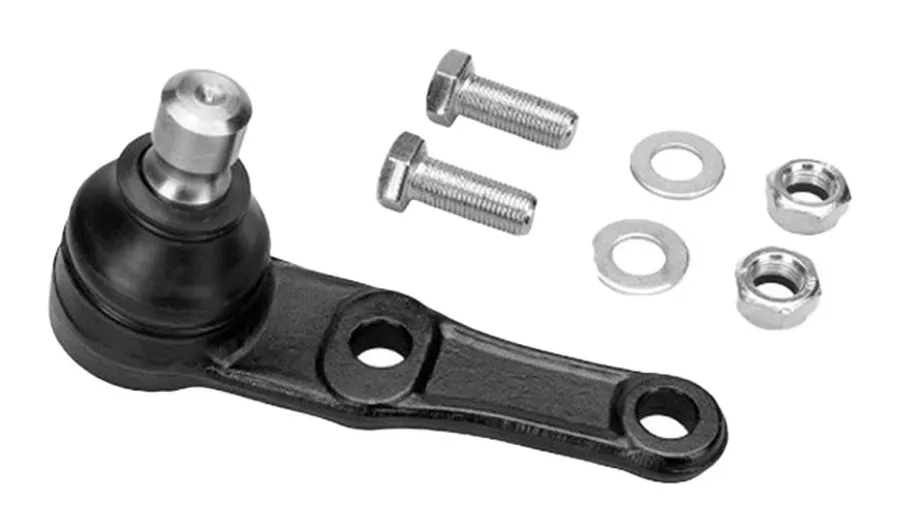
A ball joint is a spherical bearing that works as a pivot between the control arm and the steering knuckle. It “consists of a bearing stud and socket enclosed in a casing; all these parts are made of steel”, and ball joints connect “the control arms to the steering knuckles” on virtually every car. The joint lets the knuckle move with the suspension and turn with the steering at the same time.
Tie rods are “part of the steering mechanism”; unlike a structural tie rod they both push and pull. The tie rod end is the outer joint of that linkage: its ball stud sits in the steering arm of the knuckle and turns the wheel when the rack moves the rod. In the UK the assembly is generally called a track rod.
Signs of wear
| Sign | Ball joint | Tie rod end |
|---|---|---|
| Knocking or clunking over bumps | Yes | Yes |
| Noise when turning | Clicking, popping or snapping, later a squeak | Clunk or knock when turning |
| Steering pulls or drifts to one side | Yes | Yes, continually while driving |
| Loose or sloppy steering with play | Yes | Yes |
| Steering veers over bumps or under acceleration | Yes | Yes |
| Vibration through the steering wheel | Yes | Less often |
| Uneven tyre wear | Yes | Yes, on the edge of the tyre |
A worn ball joint can produce a “clicking, popping or snapping sound when the wheel is turned” that “eventually turn[s] into a squeaking sound”, and “thud noises coming from front suspension when going over bumps”. For the tie rod end the list is much the same: the vehicle “continually pulls to one side while driving”, the steering slips or drifts after turning, it feels loose, and there are knocking sounds and noises while turning.
The two joints share their symptoms because they hold the same wheel. What separates them is the direction of the play: a workshop rocks the wheel top to bottom for the ball joint, which carries the vertical load, and side to side for the tie rod end, which carries the steering load.
How a tester checks them
The steering linkage is checked with the vehicle over a pit or on a lift and the wheels on the ground. An assistant rocks the steering wheel in both directions, or wheel play detectors are used in rotational mode, while the tester watches every joint of the linkage for movement, fractures and security. For the suspension joints the wheels are jacked clear of the ground, a bar is placed under the tyre and levered upwards, and the wheel is rocked and shaken while an assistant watches the joint.
The test looks for three things at each joint:
| Finding | Judged as |
|---|---|
| A steering ball joint “with excessive wear or free play” | Major |
| A steering ball joint worn “to the extent there is a serious risk of detachment” | Dangerous |
| A suspension “pin, bush, joint or bearing excessively worn” | Major |
| A suspension joint “likely to become detached” | Dangerous |
| A ball joint dust cover “damaged or deteriorated” | Minor |
| A dust cover “missing or no longer prevents the ingress of dirt” | Major |
Why the dust boot matters
The boot keeps the grease in and the dirt out. Once it is split, the grease is washed out and grit and water reach the ball and socket, and the joint wears quickly from then on. Delphi advises technicians “to help ensure a quality steering and suspension repair by replacing the entire ball joint component where the rubber boot is split, cracked, damaged or missing”: replacing only the boot seals the contaminants in and leaves the joint without its lubrication.
What happens if a worn joint is ignored
When a ball joint fails, “the wheel’s angle becomes unconstrained, causing loss of control”. The vehicle “will come to an abrupt halt, damaging the tires”, and the debris can damage other parts of the car. A tie rod end that separates leaves that wheel without steering. Both are why a joint with play is a major defect and a joint at risk of detachment is a dangerous one.
After the repair
The tie rod end sets the toe of its wheel, so the wheel alignment is checked and set after a tie rod end or a ball joint has been replaced. Fitting the new joint with its own nut, tightened to the vehicle manufacturer’s torque, is part of the job.
FUHRLENK supplies ball joints, tie rod ends and inner tie rods for European and Japanese passenger cars, identified by OE reference.