
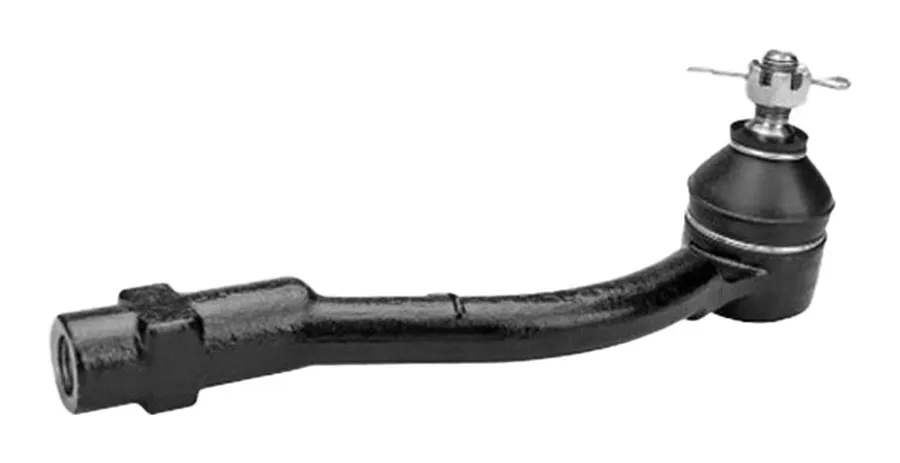
A tie rod end is the outer joint of the steering linkage. Its threaded socket screws onto the inner tie rod, and its tapered stud, a ball joint under a rubber boot, fits into the steering arm of the knuckle and is held by a nut. When the rack moves the tie rod, the tie rod end turns the knuckle and with it the wheel.
Because the tie rod is screwed into the tie rod end, the assembly also sets the toe of the front wheel. A worn tie rod end lets the wheel point wherever the road pushes it: the steering feels loose, the car wanders and pulls, there is a knock when turning and the tyre wears unevenly. A worn joint that separates leaves that wheel without steering.
FUHRLENK tie rod ends are made to the joint, the taper and the thread of the original part, with the fixing nut supplied. They are made to OEM-compliant quality and tested for durability and temperature resistance.
The range covers European and Japanese passenger cars. Each reference is identified by the OE number of the original part; send that number and the vehicle identification number (VIN) and we confirm the matching FUHRLENK reference.
For availability and OE cross-references, contact us by email.