
The short answer
A worn stabiliser link makes “a light rattling or knocking noise” from one corner of the car over speed bumps, potholes and broken surfaces, and lets the body roll more in corners. The check is simple: hold the link and move it by hand; any free play at either of its two small ball joints means the link is replaced.
What the bar and the link do
An anti-roll bar, or stabiliser bar, “helps reduce the body roll of a vehicle during fast cornering or over road irregularities” by linking the opposite wheels of an axle. “Each end of the bar is connected to an end link through a flexible joint”, and the link is “connected in turn to a spot near a wheel or axle, transferring forces from the heavily loaded side”. Flexible bushings attach the bar itself to the chassis. When the car corners, the links twist the bar, and the bar resists the roll.
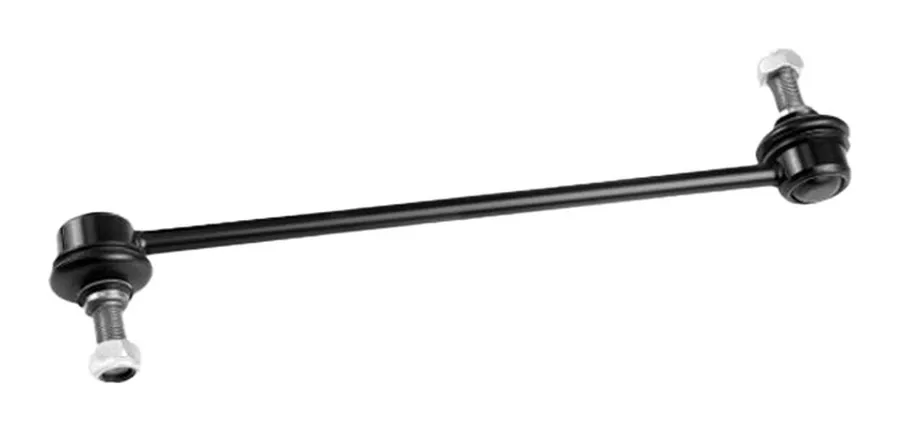
The link is the moving part of that chain. It is a short rod with a ball and socket joint at each end, sealed by a rubber boot, so it can follow the suspension on every bump without binding.
Why it fails
The two joints move with every bump, and “movement of ball and socket joints make them prone to wear”. Corrosion follows, “especially as the rubber elements age and allow moisture to get in”. Poor road surfaces, speed bumps and kerb strikes speed up the process. Once the boot has failed and the grease has gone, the stud knocks in its socket.
Signs of a worn link
| Sign | What is happening |
|---|---|
| A light rattle or knock over bumps, usually from one corner | Play in a ball joint of the link; the stud moves in its socket as the suspension moves |
| More body roll in corners | The link no longer transfers the load to the bar cleanly |
| Uneven tyre wear, if the fault is ignored for long | The handling of the axle has changed |
The noise is the symptom that brings the car in. It rarely sounds all the time; it appears when the suspension moves quickly over a short distance, which is why speed bumps and potholes bring it out.
How the link is checked
By hand first. With the vehicle on a lift or safely supported, “holding the anti-roll bar link and moving it around, you may find excess play which is a clear sign that replacement is necessary”. Each joint is moved sideways and in rotation; a click or free movement at either end condemns the link. The boots are inspected at the same time.
On a roadworthiness test the link is one of the suspension joints checked with a lever or with wheel play detectors while an assistant watches. A suspension “pin, bush, joint or bearing excessively worn” is a major defect; one “likely to become detached” is dangerous; and a dust cover “missing or no longer prevents ingress of dirt” is major on its own. A suspension component “insecurely attached to chassis or axle” or “excessively damaged or corroded” is also major.
Replacement
The wheel is removed and the threads cleaned; the old link is unbolted from the bar and from the strut or arm, and the new one fitted with “the bottom and top nuts using a torque wrench set to manufacturer specifications”. Because the link rarely wears alone, the bushings of the bar and the other joints of the same corner are checked at the same time.
FUHRLENK supplies stabiliser links for European and Japanese passenger cars, with sealed ball joints at both ends, identified by OE reference.